
On Calypso’s Island
What if staying could be a life, too?
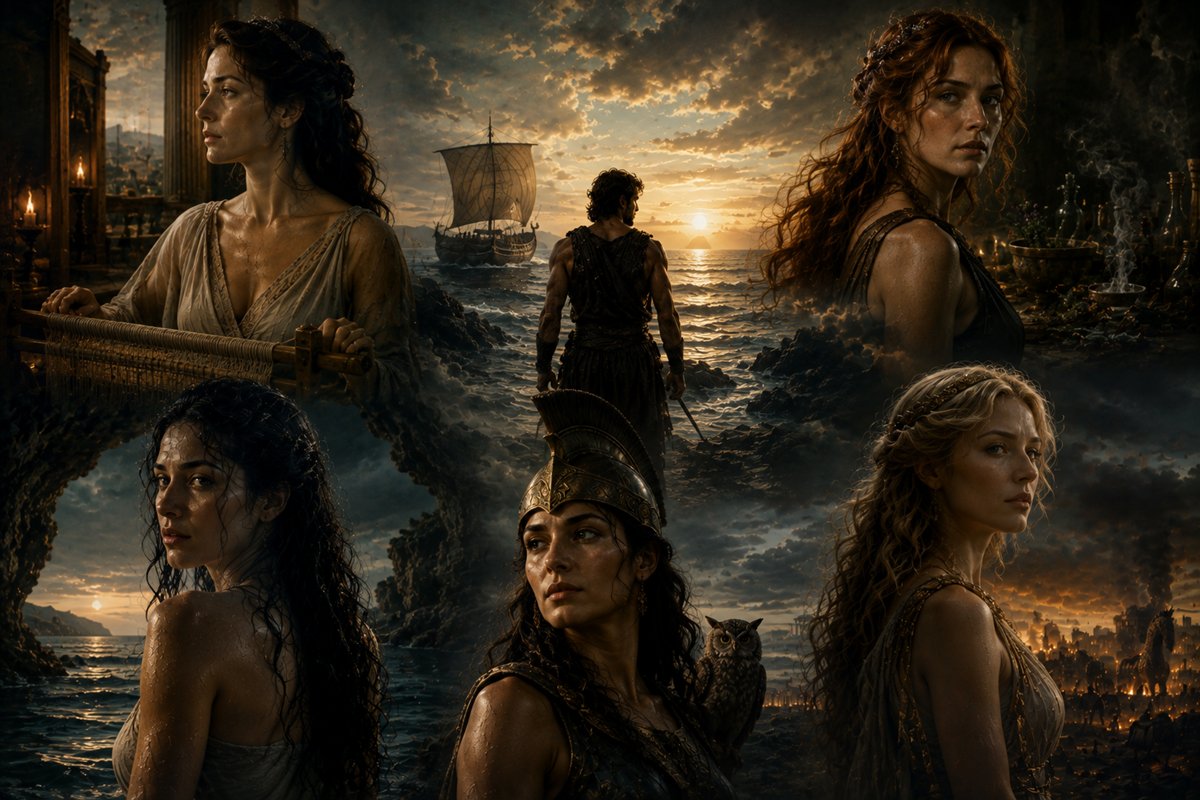
From Homer to Nolan: The Women of the Odyssey
Someone hearing Odysseus’ story for the first time might think it is the story of a man.
A warrior. A king. The cunning man who brought Troy to its knees; the hero who vanished into the sea, angered the gods, faced monsters, and finally returned home twenty years later.
Homer himself introduces us to him in the very first line:
“Tell me of that man, Muse…”
Andra.
Man.
The door to the epic opens for a man.
But every time I return to the Odyssey, I find other faces along his path.
The faces of women.
And while watching Nolan’s The Odyssey, that feeling becomes even more pronounced. The camera is often following Odysseus. It moves across the sea with him; through war, storms, monsters, and gods, always at his side.
But the weight of a story does not always lie where the camera is looking.
Sometimes, it rests on someone outside the frame.
In Penelope’s waiting.
In the body touched by Circe.
In time stretching across Calypso’s island.
In Athena’s unseen mind.
In the war carried on Helen’s face.
Homer tells us about a man.
Nolan allows us to see that man’s return all over again.
I want to look at his journey through the traces left behind by the women along his way.
Because as Odysseus travels from one island to another, he is actually passing through not six, but five different worlds created by women.
One asks him to stay.
One transforms him.
One makes him think.
One reminds him of the past.
And one, after all of this, keeps the place where he can finally return home.
I. Penelope: The Loom and the Invisible Power
Let us begin with Penelope.
Because if returning home is ever going to mean something, somewhere, someone has to keep that home possible.
Homer’s Penelope waits for Odysseus for twenty years.
But describing her simply as “the woman who waits” has always felt a little unfair to me.
Because Penelope is not merely waiting.
She controls time.
She weaves by day and unravels by night. She makes the suitors wait one more day, one more night, just a little longer. She disrupts the natural flow of time with her own hands.
In a world built around the language of male power, war, and authority, Penelope uses a much quieter weapon.
Thread.
Odysseus has his sword; Penelope has her loom.
But both know how to survive.
When I look at Penelope in Nolan’s film, I cannot think of her merely as the woman left behind in Odysseus’ absence.
Because even her absence is a presence within the story.
No matter how far Odysseus travels across the sea, the measure of his return remains in Ithaca.
Penelope is there even when she is not seen.
Perhaps this is where the strange power of cinema begins.
You do not always have to show a character.
Sometimes, you understand their presence by seeing where someone else wants to go.
Odysseus wants to go home.
But “home” is no longer simply an island.
It is the time a woman has protected for twenty years.
And perhaps that is why what moves me most about Penelope’s love is not her loyalty, but her sense of time.
To keep a place for someone without seeing them every day, without hearing their voice, without knowing whether they will ever return.
Perhaps this is one of the quietest forms of love.
Some loves do not keep you beside them.
They simply leave a light burning for you to find your way back when you are lost.
II. Circe: Transformation
Then comes Circe.
Homer’s sorceress.
That famous scene in which a woman turns men into pigs is one of the most often told transformations in mythology.
But whenever I think of Circe, the same question comes to mind:
What if she did not really change them?
What if she only made visible what was already inside them?
That is why Circe’s magic has never felt to me like merely a punishment.
Sometimes a person does not transform because of someone else.
Sometimes, what they have hidden is simply brought to light.
When we look at Nolan’s Circe, Homer’s story becomes darker again. The magic is no longer merely a fantastical encounter; it becomes a darker moment in which the body is distorted and a person becomes alien to their own form.
And so Circe ceases to be merely a woman Odysseus encounters on his journey.
She becomes a threshold.
A threshold at which you must first see what you are before you can remain human.
That is where Circe’s power lies.
She knows both healing and punishment.
She understands the language of plants. She prepares potions. She transforms.
But then she shows the way forward.
At first, she stands before Odysseus as a danger; in the end, she becomes one of the women who determines the direction of his journey.
Perhaps the power of some women lies precisely in this duality.
Both frightening and guiding.
Both wounding and healing.
Circe does not have to appear to anyone in only one form.
III. Calypso: The Possibility of Staying
But if there is one woman among all of them I keep returning to, it is Calypso.
Perhaps I love her a little too much.
Perhaps I want to understand her more than the others.
Because there is something about Calypso’s story that unsettles me.
In Homer, Odysseus is held on her island.
In Nolan, we linger longer on that captivity itself.
And suddenly the question changes.
Why can’t Odysseus return home?
becomes accompanied by,
Why doesn’t he stay here?
The difference seems small.
But it isn’t.
Because the second question gives Calypso a possibility.
It allows her to be more than an obstacle—to become the woman who opens the door to another life.
Calypso is powerful.
Immortal.
She is the owner of her own island.
She is powerful enough to offer a man immortality.
But she cannot command the heart of the man she loves.
I think that is precisely where Calypso’s tragedy lies.
Having everything does not mean you can have the thing you want.
That is why the expansion of this relationship in Nolan’s film matters.
Because Calypso is no longer merely a figure delaying Odysseus’ journey.
She is the life he did not choose.
Another time.
Another possibility.
Another Odysseus.
Calypso does not offer Odysseus only herself.
She offers him another life.
A time in which he will never grow old, never die, never have to be anywhere by any deadline.
Eternity.
But Odysseus wants to leave.
And this is where Calypso’s story grows larger for me.
Because sometimes love is wanting the person you love to stay.
But sometimes, despite all your power, it is accepting that they have to leave.
Calypso does not want to let him go.
That much is clear.
But in the end, she does.
Perhaps her greatness lies not in keeping Odysseus in her hands, but in being forced to let him go.
Calypso offered Odysseus eternity.
Penelope gave him his mortal life back.
And Odysseus chose not eternity, but the way home.
But that choice does not make Calypso’s love any smaller.
Perhaps the opposite.
Because some loves do not become worthless simply because they are not returned.
They simply become another kind of tragedy.
IV. Athena: The Unseen Mind
Athena is the invisible force in Odysseus’ story.
In Homer, she is not merely a goddess who watches.
She plans.
She intervenes.
She protects Odysseus.
She sets Telemachus in motion.
In Nolan’s world, however, the presence of the gods is felt differently.
Instead of seeing everything clearly, sometimes we see only their traces.
A voice.
A light.
A storm.
A glance.
That is why Athena’s power makes me think not only of divine protection, but of an unseen direction.
While everyone in Odysseus’ story follows his body, Athena stands where his mind is moving.
There is an old kinship between them.
Both believe not in brute force, but in intelligence.
They wait.
They hide.
They disguise themselves.
They choose the right moment.
Perhaps that is why Athena does not have to be one of the most visible characters in the film.
Because her role is not to be seen, but to give direction.
You do not always have to watch the captain to understand where a ship is going.
Sometimes it is enough to look at the wind.
V. Helen: A Woman Carrying History
Helen’s story may be the most unfairly told of all these women.
Everyone talks about her beauty.
Wars are fought because of her.
Kings die.
Cities burn.
But at some point, you have to stop and ask:
Where is Helen in all of this?
When does a woman cease to be the subject of her own story and become a symbol of someone else’s war?
Homer’s Helen carries the weight of her beauty.
When we look at Nolan’s Helen, her face begins to tell us something else.
Because cinema can linger on a face.
And a face can carry what an epic cannot put into words.
The exhaustion of war.
The weight of memory.
The silence of living inside the story other people have written about you.
That is why Helen’s beauty has never felt to me like merely a gift.
Sometimes beauty is a fate, too.
People look at her and write their own desires onto her.
They want her.
They fight for her.
They blame her.
But perhaps Helen’s greatest tragedy is that everyone speaks about her, while so little of her own voice is heard.
She seems like a woman carrying the past in her body.
A silent face left behind by a war.
And perhaps that is the saddest thing about beauty:
Becoming something everyone can see may mean that no one truly sees you.
Who Returns Home in the End?
In the end, I return to the first line.
“Tell me of that man, Muse…”
That is how Homer begins.
With a man.
Nolan continues the film with him.
We cross the sea with him.
We see the war through him.
We pass through monsters, gods, and distant islands with him.
But the meaning of the journey changes beside each woman he encounters.
Penelope gives him a place to return to.
Circe transforms him.
Calypso shows him another life he could stay for.
Athena determines his path.
Helen reminds him how heavy the past can be.
The camera is usually following Odysseus.
But the story moves forward with the weight of the women he leaves behind.
Perhaps that is why there is less a three-thousand-year distance between Homer and Nolan than there is a long look.
Homer tells us about a man.
Nolan makes us see that man’s journey again.
But when I look at the women, I notice something else:
Being at the center of a story does not always mean being the most visible.
Sometimes a character steps out of the frame.
But the direction of the story does not change.
Sometimes a woman does not speak.
But her absence determines an entire man’s journey.
And perhaps that is the greatest secret of the Odyssey.
In the first line, we are told:
“Tell me of that man,”
But for that man to make it home, he must pass through the worlds built by women along the way.
Perhaps this is the story of the man Homer tells us about.
But women carry the memory of that story.
And no matter how long Nolan’s camera follows Odysseus, after a while you begin to realize:
It is not only Odysseus who comes home.
With him arrive Penelope’s waiting, Circe’s transformation, Calypso’s longing, Athena’s mind, and Helen’s memory, all the way to Ithaca.
Perhaps the real journey begins here:
Not with a man returning home,
but with all the stories waiting for him inside that home finally falling back into place.
Calypso’nun Adasında
Ya kalmak da bir hayat olsaydı?
Homeros’tan Nolan’a: Odysseia’nın Kadınları
Odysseus’un hikâyesini ilk kez dinleyen biri, bunun bir adamın hikâyesi olduğunu düşünebilir.
Bir savaşçının. Bir kralın. Troya’yı yerle bir eden kurnaz adamın; denizlerde kaybolan, tanrıların öfkesine uğrayan, canavarlarla karşılaşan ve yirmi yıl sonra evine dönen kahramanın.
Nitekim Homeros da bizi daha ilk dizede onunla tanıştırır:
“Bana o adamı anlat, Musa…”
Andra.
Adam.
Destanın kapısı bir erkeğe açılır.
Ama ben Odysseia’yı her yeniden düşündüğümde, onun yolunun üzerinde başka yüzler görüyorum.
Kadınların yüzlerini.
Ve Nolan’ın The Odyssey’sini izlerken bu duygu daha da belirginleşiyor. Kamera çoğu zaman Odysseus’un peşinde. Denizin üzerinde onunla birlikte ilerliyor; savaşın, fırtınanın, canavarların ve tanrıların arasından onunla geçiyor.
Ama hikâyenin ağırlığı her zaman kameranın baktığı yerde değil.
Bazen kadrajın dışında kalan birinin üzerinde.
Penelope’nin bekleyişinde.
Kirke’nin dokunduğu bedende.
Kalypso’nun adasında uzayan zamanda.
Athena’nın görünmeyen aklında.
Helena’nın yüzünde taşınan savaşta.
Homeros bize bir adamı anlatır.
Nolan ise o adamın dönüşünü yeniden görmemizi sağlar.
Ben ise onun yolculuğuna kadınların bıraktığı izlerden bakmak istiyorum.
Çünkü Odysseus bir adadan diğerine yolculuk ederken, aslında kadınların kurduğu altı değil, beş farklı dünyanın içinden geçer.
Biri ona kalmasını söyler.
Biri dönüşmesini.
Biri düşünmesini.
Biri geçmişi hatırlatır.
Ve biri, bütün bunların sonunda, eve dönebileceği yeri korur.
I. Penelope: İplik ve Görünmeyen Hükümdarlık
Penelope ile başlayalım.
Çünkü eve dönüşün bir anlamı olacaksa, bir yerde birinin o evi hâlâ mümkün kılması gerekir.
Homeros’un Penelope’si yirmi yıl boyunca Odysseus’u bekler.
Ama onu yalnızca “bekleyen kadın” olarak anlatmak, bana her zaman biraz haksızlık gibi gelmiştir.
Çünkü Penelope’nin yaptığı şey yalnızca beklemek değildir.
O zamanı yönetir.
Gündüz dokuduğunu gece söker. Talipleri bir gün daha, bir gece daha, biraz daha bekletir. Zamanın doğal akışını kendi elleriyle bozar.
Erkeklerin güç, savaş ve iktidar diliyle kurduğu bir dünyada, Penelope çok daha sessiz bir silah kullanır.
İplik.
Odysseus’un kılıcı vardır; Penelope’nin ise tezgâhı.
Ama ikisi de hayatta kalmanın yollarını bilir.
Nolan’ın filminde de Penelope’ye baktığımda, onu yalnızca Odysseus’un yokluğunda kalan kadın olarak düşünemiyorum.
Çünkü onun yokluğu bile hikâyenin içinde bir varlıktır.
Odysseus denizlerde ne kadar yol alırsa alsın, dönüşünün ölçüsü Ithaka’da kalmıştır.
Penelope görünmediğinde bile oradadır.
Belki sinemanın tuhaflığı da burada başlar.
Bir karakteri her zaman göstermek gerekmez.
Bazen onun varlığını, başka birinin nereye gitmek istediğinden anlarsınız.
Odysseus eve dönmek ister.
Ama “ev” dediği şey yalnızca bir ada değildir artık.
Bir kadının yirmi yıl boyunca koruduğu zamandır.
Ve belki bu yüzden Penelope’nin aşkında beni en çok etkileyen şey sadakatinden önce zaman duygusudur.
Bir insanı her gün görmeden, sesini duymadan, geri dönüp dönmeyeceğini bilmeden onun için bir yer tutmak.
Aşkın en sessiz biçimlerinden biri bu olabilir.
Bazı aşklar insanı yanında tutmaz.
Yalnızca kaybolduğunda geri dönebileceği bir ışık yakar.
II. Kirke: Dönüşüm
Sonra Kirke gelir.
Homeros’un büyücüsü.
Bir kadının insanları domuza çevirdiği o ünlü sahne, mitolojinin en çok anlatılan dönüşümlerinden biridir.
Ama Kirke’yi her düşündüğümde aklıma aynı soru gelir:
Ya onları gerçekten değiştirmediyse?
Ya yalnızca zaten içlerinde olan şeyi görünür hâle getirdiyse?
Kirke’nin büyüsü bana bu yüzden hiçbir zaman yalnızca bir ceza gibi gelmedi.
İnsan bazen bir başkasının elinde dönüşmez.
Bazen yalnızca, sakladığı şey açığa çıkar.
Nolan’ın Kirke’sine baktığımızda Homeros’un hikâyesi yeniden sertleşir. Büyü artık yalnızca masalsı bir karşılaşma değildir; bedenin bozulduğu, insanın kendi biçimine yabancılaştığı daha karanlık bir ana dönüşür.
Ve böylece Kirke, Odysseus’un yolculuğunda yalnızca karşısına çıkan bir kadın olmaktan çıkar.
Bir eşik olur.
İnsan kalabilmek için önce ne olduğunu görmek zorunda olduğu bir eşik.
Kirke’nin gücü de tam burada.
O hem şifayı hem cezayı bilir.
Bitkilerin dilinden anlar. İksir hazırlar. Dönüştürür.
Ama sonra yol gösterir.
Odysseus’un karşısında önce bir tehlike olarak dururken, sonunda onun yolculuğunun yönünü belirleyen kadınlardan birine dönüşür.
Belki bazı kadınların gücü tam da bu ikilikte saklıdır.
Hem korkutucu hem yol gösterici.
Hem yaralayan hem iyileştiren.
Kirke kimseye tek bir biçimde görünmek zorunda değildir.
III. Kalypso: Kalmanın İhtimali
Ama bütün bu kadınların arasında benim dönüp dönüp baktığım biri varsa, o Kalypso’dur.
Belki onu biraz fazla seviyorum.
Belki de onu diğerlerinden daha fazla anlamak istiyorum.
Çünkü Kalypso’nun hikâyesinde beni rahatsız eden bir şey vardır.
Homeros’ta Odysseus onun adasında tutulur.
Nolan’da ise bu tutulmanın kendisine daha uzun bakarız.
Ve birden soru değişir.
Odysseus neden eve dönemiyor?
sorusunun yanına,
Neden burada kalmıyor?
sorusu gelir.
Aradaki fark küçüktür.
Ama değildir.
Çünkü ikinci soru Kalypso’ya bir ihtimal verir.
Ona yalnızca bir engel değil, başka bir hayatın kapısını açan kadın olma imkânı verir.
Kalypso güçlüdür.
Ölümsüzdür.
Kendi adasının sahibidir.
Bir erkeğe ölümsüzlük vaat edebilecek kadar güçlüdür.
Ama sevdiği adamın kalbine hükmedemez.
Bence Kalypso’nun trajedisi tam olarak budur.
Her şeye sahip olmak, insanın istediği şeye de sahip olabileceği anlamına gelmez.
Nolan’ın filminde bu ilişkinin genişlemesi de bu yüzden önemlidir.
Çünkü Kalypso artık yalnızca Odysseus’un yolculuğunu geciktiren bir figür değildir.
Onun seçmediği hayatın kendisidir.
Bir başka zaman.
Bir başka ihtimal.
Bir başka Odysseus.
Kalypso Odysseus’a yalnızca kendisini sunmaz.
Ona başka bir hayat sunar.
Yaşlanmayacağı, ölmeyeceği, hiçbir yere yetişmek zorunda olmayacağı bir zaman.
Sonsuzluğu.
Ama Odysseus gitmek ister.
Ve işte Kalypso’nun hikâyesi benim için tam burada büyür.
Çünkü aşk bazen sevdiğin insanın kalmasını istemektir.
Ama bazen, bütün gücüne rağmen onun gitmesi gerektiğini kabul etmektir.
Kalypso onu bırakmak istemez.
Bu çok açık.
Ama sonunda bırakır.
Belki de büyüklüğü Odysseus’u elinde tutmasında değil, onu göndermek zorunda kalmasında saklıdır.
Kalypso, Odysseus’a sonsuzluğu sundu.
Penelope ise ona sonlu hayatını geri verdi.
Ve Odysseus, sonsuzluğu değil, eve dönmeyi seçti.
Ama bu seçim, Kalypso’nun aşkını daha küçük yapmaz.
Belki tam tersine.
Çünkü bazı aşklar karşılık bulmadığında değersizleşmez.
Sadece başka bir trajediye dönüşür.
IV. Athena: Görünmeyen Akıl
Athena, Odysseus’un hikâyesindeki görünmez güçtür.
Homeros’ta yalnızca izleyen bir tanrıça değildir.
Plan kurar.
Müdahale eder.
Odysseus’u korur.
Telemakhos’u harekete geçirir.
Nolan’ın dünyasında ise tanrıların varlığı daha farklı bir biçimde hissedilir.
Her şeyi açıkça görmek yerine, bazen yalnızca izlerini görürüz.
Bir ses.
Bir ışık.
Bir fırtına.
Bir bakış.
Bu yüzden Athena’nın gücü bana yalnızca tanrısal bir korumayı değil, görünmeyen bir yönü düşündürür.
Odysseus’un hikâyesinde herkes onun bedenini takip ederken, Athena onun zihninin hareket ettiği yerde durur.
İkisi arasında eski bir akrabalık vardır.
İkisi de doğrudan güce değil, zekâya inanır.
Beklerler.
Saklanırlar.
Kılık değiştirirler.
Doğru zamanı seçerler.
Belki Athena bu yüzden filmin en görünür karakterlerinden biri olmak zorunda değildir.
Çünkü onun işi görünmek değil, yön vermektir.
Bir geminin nereye gittiğini anlamak için her zaman kaptanı izlemek gerekmez.
Bazen rüzgârın yönüne bakmak yeterlidir.
V. Helena: Bir Kadının Taşıdığı Tarih
Helena’nın hikâyesi belki de bütün bu kadınlar arasında en haksız anlatılmış olanıdır.
Onun güzelliği hakkında herkes konuşur.
Onun yüzünden savaşlar çıkar.
Krallar ölür.
Şehirler yanar.
Ama bir noktada insan durup şunu sormak ister:
Helena bütün bunların neresindedir?
Bir kadın ne zaman kendi hikâyesinin öznesi olmaktan çıkar ve başkalarının savaşının sembolüne dönüşür?
Homeros’un Helena’sı güzelliğinin ağırlığını taşır.
Nolan’ın Helena’sına baktığımızda ise yüzün kendisi başka bir şey anlatmaya başlar.
Çünkü sinema bir yüze uzun uzun bakabilir.
Ve bir yüz, bir destanın anlatamadığı şeyi taşıyabilir.
Savaşın yorgunluğunu.
Hatırlamanın ağırlığını.
Başkalarının senin hakkında kurduğu hikâyenin içinde yaşamanın sessizliğini.
Helena’nın güzelliği bana bu yüzden hiçbir zaman yalnızca bir armağan gibi gelmez.
Bazen güzellik de bir kaderdir.
İnsanlar ona bakar ve kendi arzularını onun üzerine yazar.
Onu isterler.
Onun için savaşırlar.
Onu suçlarlar.
Ama belki Helena’nın en büyük trajedisi, herkesin onun hakkında konuşması ve onun kendi sesinin bu kadar az duyulmasıdır.
O, geçmişi bedeninde taşıyan bir kadın gibi durur.
Bir savaşın ardından kalan sessiz bir yüz.
Ve belki güzelliğin en hüzünlü tarafı da budur:
Herkesin gördüğü bir şey hâline gelmek, kimsenin seni gerçekten görmemesi olabilir.
Sonunda Eve Dönen Kim?
Sonunda yeniden ilk dizeye dönüyorum.
“Bana o adamı anlat, Musa.”
Homeros böyle başlar.
Bir adamla.
Nolan da filmi onunla sürdürür.
Denizi onunla aşarız.
Savaşı onunla görürüz.
Canavarların, tanrıların ve uzak adaların içinden onunla geçeriz.
Ama yolculuğun anlamı, her seferinde başka bir kadının yanında değişir.
Penelope ona döneceği yeri verir.
Kirke onu dönüştürür.
Kalypso ona kalabileceği başka bir hayat gösterir.
Athena yolunu belirler.
Helena geçmişin ne kadar ağır olabileceğini hatırlatır.
Kamera çoğu zaman Odysseus’un peşindedir.
Ama hikâye, onun arkasında bıraktığı kadınların ağırlığıyla ilerler.
Belki bu yüzden Homeros ile Nolan arasında üç bin yıllık bir mesafeden çok, uzun bir bakış vardır.
Homeros bize bir adamı anlatır.
Nolan o adamın yolculuğunu yeniden görür.
Ben ise kadınlara bakınca başka bir şey fark ederim:
Bir hikâyenin merkezinde olmak, her zaman en çok görünmek değildir.
Bazen bir karakter kadrajdan çıkar.
Ama hikâyenin yönü değişmez.
Bazen bir kadın konuşmaz.
Ama onun yokluğu, bir erkeğin bütün yolculuğunu belirler.
Ve belki Odysseia’nın en büyük sırrı da budur.
İlk dizede bize:
“Bana o adamı anlat,”
denir.
Ama adamın eve dönebilmesi için, yol boyunca kadınların kurduğu dünyalardan geçmesi gerekir.
Belki Homeros’un anlattığı adamın hikâyesidir bu.
Ama o hikâyenin hafızasını kadınlar taşır.
Ve Nolan’ın kamerası ne kadar uzun süre Odysseus’un peşinde giderse gitsin, insan bir süre sonra şunu fark eder:
Eve dönen yalnızca Odysseus değildir.
Onunla birlikte, Penelope’nin bekleyişi, Kirke’nin dönüşümü, Kalypso’nun arzusu, Athena’nın aklı ve Helena’nın hafızası da Ithaka’ya varır.
Belki gerçek yolculuk tam burada başlar:
Bir adamın eve dönmesiyle değil,