
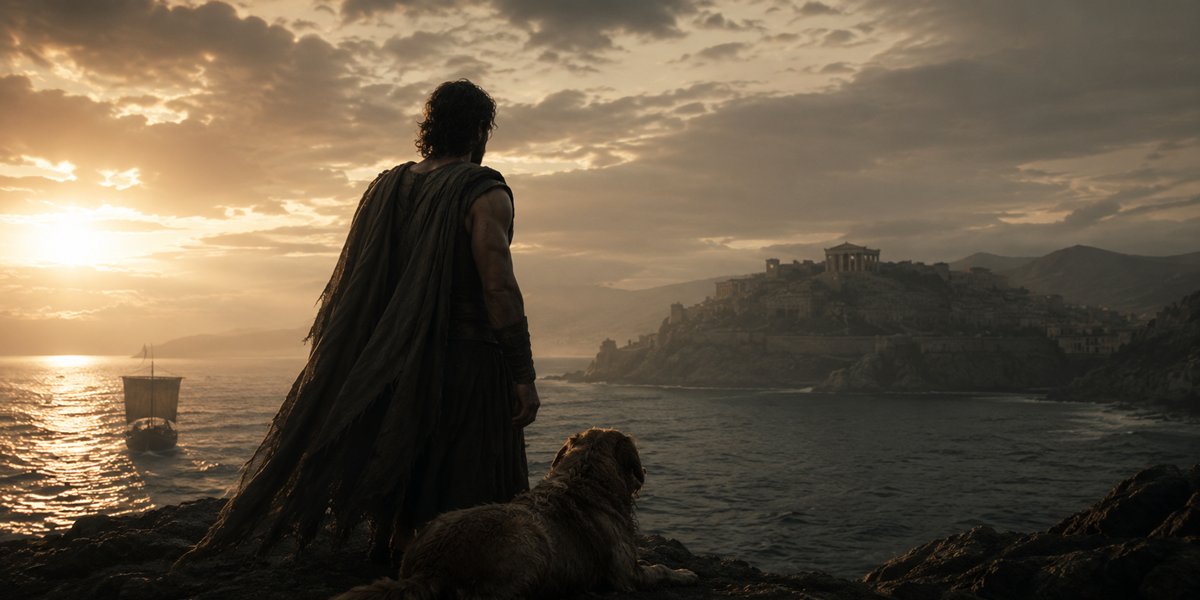
Returning Home
A Philosophical Reading of Christopher Nolan’s The Odyssey
Christopher Nolan’s The Odyssey is more than a cinematic retelling of Homer’s epic. It is an invitation to reflect on memory, identity, belonging, and the enduring human desire to return—not merely to a place, but to oneself. This essay explores Odysseus’ journey through the philosophical lenses of Gaston Bachelard and Paul Ricoeur, asking whether home is ever truly a destination.
“Take me home.”
My grandmother is ninety-three years old.
Lately, she says the same sentence to me every single day.
At first, I tried to correct her.
“Grandma, you are already home.”
She looks around the room she has lived in for years. The furniture is familiar. The walls are familiar. Yet none of it seems to belong to her anymore.
She slowly shakes her head.
“No,” she whispers. “Take me home.”
Eventually, I stopped trying to convince her.
Because I realized we were using the same word while talking about entirely different places.
I was speaking about an address.
She was speaking about a moment in time.
Perhaps a feeling.
Perhaps a home that only existed within her own memory.
After watching Christopher Nolan’s The Odyssey, those words returned to me.
The strongest emotion the film left behind was not war.
Not the fall of Troy.
Not Poseidon’s wrath.
Not even the grandeur of myth itself.
Instead, one question lingered long after the credits rolled.
Can we ever truly go home?
Nolan’s Odysseus is not simply a hero trying to reach Ithaca.
His journey becomes something far more intimate—a long, exhausting return toward the deepest parts of one’s own existence.
Ithaca is not merely an island.
It is Penelope.
It is Telemachus.
It is a shared life waiting beyond the sea.
But beyond all of these things, Ithaca becomes Odysseus himself.
Because sometimes we do not long for a country.
We long for the truest version of ourselves.
That is why the Sirens have always seemed to me to be one of the epic’s most profound moments.
Odysseus orders his crew to seal their ears with wax.
But he does not silence himself.
Instead, he asks to be tied to the mast.
He wants to hear the song.
He refuses to deny it.
He refuses to flee from it.
Yet he refuses to follow it.
The scene is not merely about resisting temptation.
It is about choosing one’s own existence.
The Sirens do not simply sing of death.
They sing of other lives.
Other possibilities.
Other versions of ourselves.
Odysseus hears them.
He desires them.
Yet he still chooses Ithaca.
By binding himself to the mast, he is, in truth, binding himself to his own life.
Gaston Bachelard once described the childhood home as our first universe.
Years ago, that sentence fascinated me.
Today, it speaks differently.
Perhaps home is our first experience of being.
The first place where we were loved.
Where we first learned fear.
Where we first waited.
Where we first belonged.
That is why the house we grew up in never truly leaves us.
It quietly becomes one of the architects of who we are.
Paul Ricoeur reminds us that memory is not an archive preserving the past, but a story constantly rewritten.
Perhaps that is why none of us ever truly returns home.
Because we change.
The house changes.
Memory changes.
What remains are fragments.
Over time they grow over one another like ivy.
They hide the details.
Leaving only a few illuminated rooms behind.
And for the rest of our lives, we keep trying to find our way back to them.
The moment that moved me most in the film was Argos.
After waiting for twenty years, the old dog recognizes Odysseus immediately, despite his disguise.
Time means nothing.
Appearance means nothing.
Even age means nothing.
Argos does not recognize who Odysseus appears to be. He recognizes who he has remained.
Then, quietly, he dies.
As I watched that scene, my grandmother’s voice returned once again.
“Take me home.”
Perhaps that was the home she had been searching for all along.
A place where she never had to explain herself.
A voice that still knew her name.
A gaze that recognized her without hesitation.
Perhaps home begins long before walls ever do.
By the end of the film, Nolan left me with one final thought.
Odysseus does not cross the seas merely to reach home.
He resists the Sirens.
He refuses Calypso’s promise of immortality.
He leaves Circe’s suspended world behind.
Because sometimes returning home means refusing the easier life.
It means choosing the life that is truly yours.
Perhaps that is why Ithaca is not simply a place.
It is a way of being.
And perhaps all of us, without fully realizing it, spend our entire lives making the same journey.
Toward ourselves.
Toward home.
Eve Dönmek
Christopher Nolan’ın The Odyssey filmi üzerine felsefi bir okuma
Christopher Nolan’ın The Odyssey filmi, Homeros’un destanını yeniden anlatmanın ötesine geçerek eve dönüş, hafıza, kimlik ve aidiyet üzerine güçlü sorular soruyor. Bu yazı, Odysseus’un yolculuğunu Gaston Bachelard ve Paul Ricoeur’nün düşünceleri eşliğinde, insanın kendi hakikatine dönüşü üzerinden yeniden okumayı deniyor.
“Beni evime götürün.”
Büyükannem doksan üç yaşında. Son zamanlarda bana her gün aynı cümleyi söylüyor.
Başlarda onu düzeltmeye çalışıyordum.
“Babaanne, zaten evindesin.”
Etrafına bakıyor. Yıllardır yaşadığı odada tanıdığı eşyaları görüyor ama onların hiçbirini kendi evi olarak kabul etmiyor. Sonra başını usulca sallıyor.
“Hayır,” diyor. “Beni evime götürün.”
Bir süre sonra onu ikna etmeye çalışmayı bıraktım. Çünkü anladım ki aynı kelimeyi kullanıyor olsak da aynı yerden söz etmiyoruz.
Ben bir adresi tarif ediyordum.
O ise bir zamanı.
Belki de bir duyguyu.
Belki de yalnızca kendisinin bildiği bir evi.
Christopher Nolan’ın The Odyssey filmini izledikten sonra bu cümle yeniden zihnime geldi.
Filmin bende bıraktığı en güçlü duygu savaş değildi.
Ne Truva’nın yıkılışı…
Ne Poseidon’un öfkesi…
Ne de destanın görkemiydi.
Geriye yalnızca tek bir soru kaldı.
İnsan gerçekten eve dönebilir mi?
Nolan’ın Odysseus’u yalnızca İthaka’ya ulaşmaya çalışan bir kahraman değildir. Onun yolculuğu, insanın kendi köklerine, kendi varoluşuna doğru yaptığı uzun ve yorucu bir yolculuktur.
İthaka yalnızca bir ada değildir.
Orada Penelope vardır.
Oğlu Telemakhos vardır.
Yaşanmış bir hayat vardır.
Ama bütün bunların ötesinde, İthaka Odysseus’un kendisidir. Çünkü insan bazen bir ülkeye değil, kendi hakikatine dönmek ister.
Bu yüzden Sirenler sahnesi beni her zaman destanın en derin anlarından biri gibi düşündürmüştür.
Odysseus, tayfalarına kulaklarını balmumuyla kapatmalarını söyler.
Ama kendisi kulaklarını kapatmaz.
Tam tersine.
Kendisini geminin direğine bağlatır.
Şarkıyı bütün açıklığıyla duymak ister.
Onu inkâr etmez.
Ondan kaçmaz.
Ama peşinden de gitmez.
Bence bu sahne yalnızca ayartılmaya karşı bir önlem değildir.
İnsanın kendi varoluşunu seçmesidir.
Çünkü Sirenlerin sesi yalnızca ölümün sesi değildir.
Başka hayatların…
Başka ihtimallerin…
Başka benliklerin çağrısıdır.
Odysseus onları duyar.
Onları arzular.
Ama yine de İthaka’yı seçer.
Kendisini direğe bağlaması, aslında kendi hayatına bağlanmasıdır.
Gaston Bachelard, çocukluk evini insanın ilk evreni olarak tanımlar.
Bu cümleyi yıllar önce okuduğumda etkilenmiştim.
Ama bugün bana başka bir şey söylüyor.
Belki de ev, insanın ilk varoluş deneyimidir.
İlk kez sevildiği…
İlk kez korktuğu…
İlk kez beklediği…
İlk kez ait olduğu yer.
Bu yüzden çocukluğumuzun evi yalnızca belleğimizde kalmaz.
Kim olduğumuzun da sessiz mimarı olur.
Paul Ricoeur, belleğin geçmişi saklayan bir arşiv değil, onu sürekli yeniden anlatan bir hikâye olduğunu söyler.
Belki bu yüzden eve hiçbir zaman gerçekten dönemeyiz.
Çünkü hem biz değişiriz…
Hem ev değişir…
Hem de belleğimiz.
Geriye yalnızca anılar kalır.
Onlar da zamanla bir sarmaşık gibi birbirlerini örter.
Ayrıntıları sessizce gizler.
Yalnızca birkaç ışıklı odayı açık bırakırlar.
Biz de ömrümüz boyunca o odalara dönmeye çalışırız.
Filmin sonunda beni en çok etkileyen sahne Argos’tu.
Yirmi yıl boyunca bekleyen yaşlı köpek, dilenci kılığına girmiş Odysseus’u tek bakışta tanır.
Ne zamanı önemser.
Ne yüzünü.
Ne de değişen bedenini.
Argos, Odysseus’un kim olduğunu değil, kim olarak kaldığını tanır.
Sonra sessizce ölür.
O sahneyi izlerken büyükannemin sesi yeniden kulağımda yankılandı.
“Beni evime götürün.”
Belki onun aradığı ev de buydu.
Kendisini açıklamak zorunda olmadığı bir dünya.
Adının söylendiği bir ses.
Hiç değişmeden tanındığı bir bakış.
Belki ev, duvarlardan önce budur.
Nolan’ın filmi bana sonunda şunu düşündürdü:
Odysseus eve dönmek için yalnızca denizleri aşmaz.
Sirenlerin çağrısına direnir.
Kalypso’nun ölümsüzlük vaadini reddeder.
Kirke’nin zamanını geride bırakır.
Çünkü bazen eve dönmek, daha kolay hayatları reddetmektir.
İnsanın kendi kaderini seçmesidir.
Belki de bu yüzden İthaka yalnızca bir coğrafya değildir.
Bir varoluş biçimidir.
Ve belki hepimiz, hayatımız boyunca, farkında olmadan aynı yolculuğu yapıyoruz.